ʻIolani Palace, at Key Anniversary, Still Sheds Light on Hawaiian Royal Life
As the Friends of ‘Iolani Palace celebrates 60 years of nonprofit stewardship, its staff and volunteers carry their mission forward – guiding tours and hosting events that educate both visitors and residents on Hawai‘i’s remarkable and, at times, painful history.
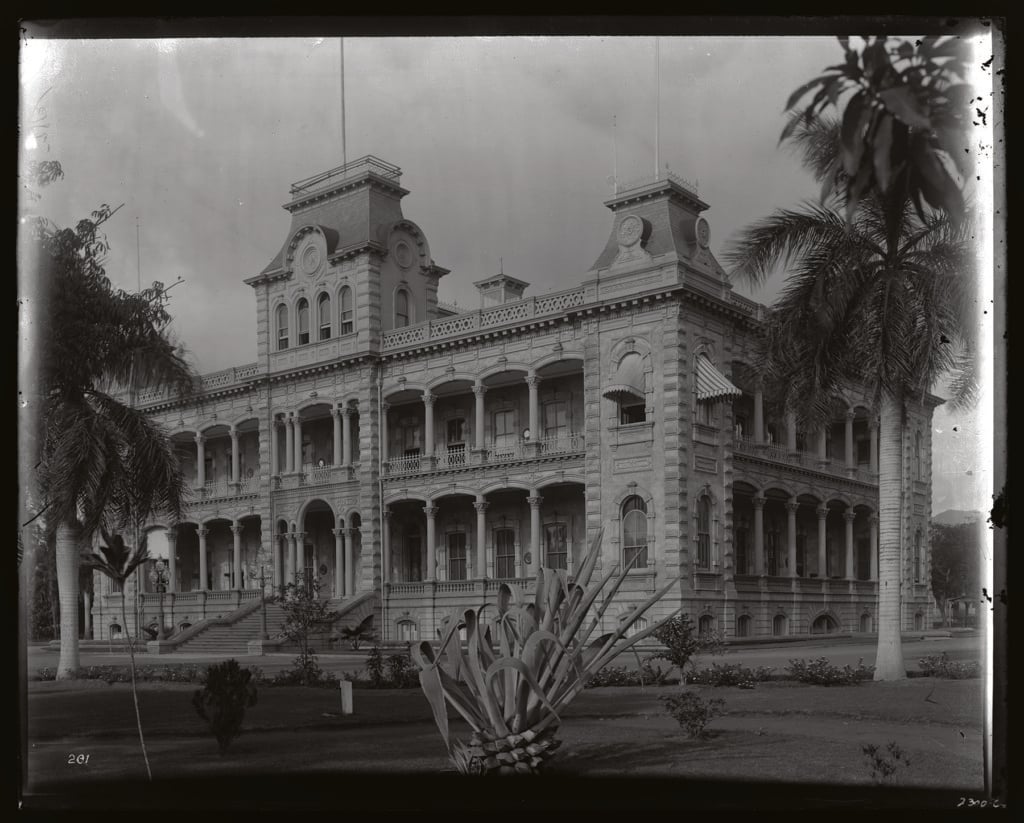
‘Iolani Palace – the residence of Hawai‘i’s last reigning monarchs – still radiates opulence and grace in the heart of Honolulu, commanding a regal presence on the corner of King and Richards Streets for more than a century.
Its ornate 19th-century architecture stands in stark contrast to the surrounding cityscape. Step inside and be transported back to an era of prestige and sophistication, when the palace served as the seat of the Kingdom of Hawai‘i until Queen Lili‘uokalani was overthrown in an 1893 coup d’état.
More than 130 years later, the palace attracts some 100,000 visitors a year, tourists from afar and residents from across the state. This year also marks 60 years since The Friends of ‘Iolani Palace nonprofit was formed to maintain its structures and to share its rich collections with the public.

Paula Akana, President and CEO of The Friends of ‘Iolani Palace. Photo: Ryann Noelani Coules
Paula Akana, president and CEO of The Friends of ‘Iolani Palace, says the building provides a history lesson vital for visitors and locals alike: “I think it’s really important that our young people know that history and understand the trials and tribulations, and all the wonderful accomplishments” of the Hawaiian Kingdom. “And when visitors come here, I’m hoping they’ll gain a better understanding of what Hawai‘i was, is, and could be.”
A Capital Takes Hold (1845-1882)
In 1845, King Kamehameha III moved the kingdom’s capital from Lahaina on Maui to Honolulu. The first palace on the site was a spacious wooden residence that housed five kings, from Kamehameha III to Kalākaua.
After a termite infestation forced the demolition of that original structure in 1874, King Kalākaua commissioned a grand residence fit for formal state ceremonies, lavish entertainment and official government business. “So, they built the palace, a very royal palace,” says Akana. The building was completed in 1882.
“I think [Kalākaua] really wanted to show people when they came here that it wasn’t just this tiny island place. It was a very modern kingdom, with lighting and plumbing and telephones and an opera house,” she says.
The palace’s state-of-the-art amenities reflected its forward-thinking leadership. Kalākaua, whose nickname was the “Merrie Monarch,” was known for being charismatic and worldly.
“I think of Kalākaua as being a Renaissance man because he was truly enamored with anything that was modern that he felt he could bring back or utilize for his people. But he still had that one foot firmly planted in the past, like in bringing back hula,” says Akana.
One of the cutting-edge amenities he pushed for was electric lighting, which ‘Iolani Palace had four years before the White House.
“Kalākaua met Thomas Edison when he was traveling around the world. He went to the first-ever exposition of electricity in Paris and saw all kinds of wonderful things there, rode the initial electric streetcar. And then, when he was in New York City, made arrangements to visit Thomas Edison. And according to one of the New York City newspapers, he asked insightful, intelligent questions, and they had a wonderful time talking about this new technology,” says Palace Historian Zita Cup Choy, who started out as a volunteer docent in 1977. Next year marks her 50th anniversary working at the palace.
Both Cup Choy and Akana have administrative offices at the adjacent Kana‘ina Building, which dates back to 1906. “This is a special building because it was the first building in the United States built specifically to house an archive,” Akana says.
A new Hawai‘i State Archives building was constructed directly behind it in 1953. It remains an essential hub for the palace team, who regularly dig through its vast collection of historical documents, newspapers and photographs to uncover more information.
“I think there’s a lot of misconceptions that have happened over the years, so we use primary sources for everything,” says Akana. “And as more Hawaiian language newspapers are being translated, we’re finding out more details about our ali‘i and about life in Hawai‘i, and so our docents can start adding that into their tours a little bit.”
The Golden Age (1882-1893)

As the largest room in ʻIolani Palace, the Throne Room hosted formal audiences, diplomatic receptions, and state balls for King Kalākaua and Queen Kapiʻolani. It is also where Queen Liliʻuokalani was tried and found guilty of misprision of treason in 1895. Photo courtesy of The Friends of ʻIolani Palace
King Kalākaua and Queen Kapi‘olani were the first royals to reside at the second ‘Iolani Palace, where they often hosted balls and meetings over breakfast, lunch and dinner. “Breakfast more times than any other meal,” notes Cup Choy. There’d be “music by the Royal Hawaiian Band and opportunity to talk story.”
Instead of sitting at the head of the dining table, the king’s chair was always in the middle “because he wanted to talk to everybody and hear from everybody,” Akana explains.
Their many guests included foreign royalty, diplomats, inventors, judges, scientists, businessmen and Hawaiian subjects. “He got a lot of grief for his entertaining. ‘You’re spending all this money.’ … The more research I do, the more convinced I am he was networking. Networking big time,” says Cup Choy.
The monarchy’s diplomatic prowess is reflected throughout the palace in gifts from foreign powers. In the Blue Room hangs a portrait of King Louis Philippe, gifted by France to Kamehameha III in 1848. In alcoves on either side of the grand staircase sit ornate cloisonné vases presented to Kalākaua by Emperor Meiji of Japan during his 1881 world tour. And in the Throne Room, foreign royal orders from nations including Great Britain, Germany, Spain, Belgium, Siam (known today as Thailand) and Japan hang mounted in gilt oval frames on the walls.
While the first floor is dedicated to formal staterooms, the second floor contains the private living quarters. Although both the king and queen had separate bedrooms in the palace, they mainly slept at the nearby Hale ‘Ākala, also known as the Pink Bungalow, which was demolished in 1919.
The palace bedrooms were “not really used for sleeping in. Maybe used for preparing for an event, getting dressed, ‘I’m going to take a nap after lunch before my evening meeting.’ That kind of thing,” explains Cup Choy.
Also upstairs is one of Akana’s favorite rooms, the King’s Library. Doubling as his private office, Kalākaua spent hours reading, writing and handling governance there.
“He had fascinating books,” including a book on Pompeii and one of the first editions of Don Quixote, she says. “When I walk in there, I can picture him writing to the Beijing emperor or something. I feel the presence of everybody in the palace, but I really feel like I can get him in there.”

Several books from King Kalākaua’s private collection eventually surfaced in Hawaiʻi state libraries. “Somewhere down the line, they were donated to the library with his bookplate in there,” Akana says. Photo courtesy of Hawaiʻi State Archives
These details only scratch the surface of the palace’s heyday. If you want to learn more, docents lead guided tours Tuesday through Saturday that narrate a comprehensive history of the landmark and offer an intimate look into the lives of Hawai‘i’s royalty.
As a museum, Cup Choy says, the “message is, ‘We were modern. We were educated. Technologically advanced. We had diplomatic representatives to over 120 cities internationally. This is who we were in the 19th century and we want to be proud of who we were, and support knowing that history.’”
The Overthrow and the Queen’s Quilt (1893-1969)
After King Kalākaua died in 1891, his sister, Queen Lili‘uokalani succeeded him. She served as the Kingdom of Hawai‘i’s last reigning monarch until she was overthrown on January 17, 1893, in a coup orchestrated by the Committee of Safety – a group of mostly American and European sugar planters, businessmen, lawyers and missionary descendants, with backing from U.S. government and military officials.
After an 1895 attempt to restore the queen to power, many of her supporters were arrested. “She abdicated in late January so that the people that had been convicted of treason, who had been sentenced to death, would have their sentence commuted to life in prison,” explains Cup Choy.
Lili‘uokalani herself was arrested for knowledge of rebellion plans and placed under house arrest at the palace within what became known as her Imprisonment Room. “So, she was isolated, and spent time arranging flowers, writing letters, writing music, reading the Book of Common Prayer,” says Cup Choy. The queen was not allowed any visitors except for one lady companion during this time.
Cup Choy says they kept her isolated because, they reasoned, “If she’s allowed to communicate with their supporters, they’ll be back. She and her friends will be back in power, and we’ll be the ones in jail. So, keep her isolated.”

The Queen’s Quilt sits on display in the second-floor corner room where Queen Liliʻuokalani was imprisoned for nearly eight months following the 1895 counter-revolution. Prior to her confinement, the space served as a palace guest bedroom. Photo courtesy of The Friends of ʻIolani Palace
At the center of the Imprisonment Room, which is otherwise very bare, is Lili‘uokalani’s 97” x 95” quilt, made by her and her companions. Fearing Hawaiian history and her people’s side of the story would be erased, she used the quilt as a unique form of documentation. Stitching in the center panel, in part, reads “Imprisoned at ‘Iolani Palace… We began the quilt there.”
After nearly eight months in the Imprisonment Room, Lili‘uokalani was allowed to move back into her Washington Place residence. “She was pardoned in October 1896, along with just about everybody else that had been arrested,” Cup Choy says.
Just 11 years after its completion, ‘Iolani Palace was seized following the 1893 overthrow and repurposed as the seat of a new governance – first for the Provisional Government of Hawai‘i, then for the Republic, the Territory, and finally the State.
The belongings Kapi‘olani and Lili‘uokalani did not take with them were given away or auctioned off to make space for the new government officials and their offices.
Restoring the Palace and Homecomings (1966-Present Day)
In 1966, The Friends of ‘Iolani Palace was formed by Prince Kawānanakoa’s daughter and other members of the community. The nonprofit began by doing research and then took over as stewards in 1969 – the same year the state capitol was moved to a new building after the Legislature outgrew the palace.
“The first huge push was restoration of the palace, and the second chapter was trying to bring things home. So now about 85% of what you see in there were the actual items,” explains Akana.
The process of recovering the lost heirlooms and furnishings requires research, finesse and patience. “So if you backtrack to 1978, when the palace first reopened for the public, it was really beautiful but empty, and they started trying to bring home items and get them returned,” says Akana. “They spent a lot of time nurturing different families and different people who had items.”
Cup Choy adds that they never pressure people or organizations to donate items suspected of having come from the palace, but they contact them periodically to talk story and remind them that they’re there.

After the state Legislature moved to the new capitol in 1969, The Friends of ʻIolani Palace began restoring the palace to its former glory—including repairing the Grand Staircase and reproducing the original wallpaper. Photo courtesy of Hawaiʻi State Archives
“It’s wonderful when things come home because if your kupuna bought a table or got a table because your kupuna kāne worked for Prince Kūhiō or partied with him, and got something because of that relationship, that becomes super special, which means it’s really difficult for people to let go of, and we have to just be patient,” she says.
“In one instance, there was a family that had two goblets from the dining room and four children, so the children said, ‘We can’t split it. Give it to the Palace!’” Cup Choy says. She estimates about half of the palace’s 10,000 or so items have returned home. Many of them have interesting recovery stories.
Akana says former curator Jim Bartels “went to a thrift shop, and he knew what the legs looked like on certain types of furniture, and he was pretty sure that a chair belonged to the palace. I can’t remember what the price was, but it was something like, let’s say, $4.”
The search for original artifacts – as well as the creation of historically accurate replicas – remains ongoing. “The newest item arriving is Princess Victoria Ka‘iulani’s gown, which will be unveiled on her birthday, October 16,” says Akana. Like the other replicated ali‘i garments on display, her gown is a meticulously researched reproduction tailored to her historical measurements.
The Business of Running a Museum
Restoration efforts and operating as a museum require continuous funding, which mainly comes from ticket sales. According to Akana, kama‘āina made up approximately 20% of ticket sales in 2025.
“So our number-one income producer is our ticket sales for our tours, and then we have operational funding from the state of Hawai‘i. We’re really happy that they actually make a big difference in what we do,” she says.
For their larger repair and maintenance projects, The Friends of ‘Iolani Palace collaborates closely with state and federal agencies. “DLNR is a very good landlord. One of our biggest projects was the roof. So, we had a federal grant through the Secretary of the Interior that gave us $500,000, and then DLNR matched it with almost $900,000 to do the roof,” says Akana.
The nonprofit also sustains its ongoing operations through private donations, sponsorships, gift shop sales and annual memberships.
A Milestone Year

For Akana and her team, watching local families reconnect with the palace grounds remains the true heart of their stewardship mission. Photo: Ryann Noelani Coules
This year marks the 60th anniversary of The Friends of ‘Iolani Palace, and Akana says leadership continues to look for innovative ways to better honor the palace and its legacy.
In addition to offering docent-led tours Tuesday through Saturday, the organization invites Hawai‘i residents to gather on the historic grounds for free during Kama‘āina Sundays, held on the second Sunday of every month.
“Pre-Covid, Kama‘āina Sundays were people standing in line and going on a docent tour [for free]. So, we stopped during the pandemic, obviously, and we did a lot of dreaming. We said when we reopen, we would love to make it a day on the grounds,” says Akana.
That dream has materialized into a bustling community day. The organization partners with local practitioners, artists and musicians to host hands-on workshops in lauhala weaving and lei making, alongside live hula and musical performances across the grounds. Residents are also welcome to go on self-led audio tours of the palace. “The only thing you have to spend money on is if you go to the gift shop or if you buy something from the food shop,” she adds.
For Akana and her team, watching local families reconnect with the palace grounds remains the true heart of their stewardship mission.
“We’ll see some people that’ll bring kūpuna who are born and raised here, but it had been a government building, or they’d never been in the palace at all,” says Akana. “So, seeing that kind of thing is really heartwarming.”